
RTP Request for Payment (RfP) Lifecycle
A Request for Payment (RfP) asks a payer's bank to push funds to Sila over the RTP network. Sila sends RfPs through Trice, an RTP and FedNow service provider. The account owner at the payer's bank has to approve the request before any money moves. This guide covers each status an RfP can reach after Sila submits it to Trice, and what each status means for the Sila transaction.
The payer's bank, not Sila or Trice, decides how and whether the account owner is notified, and this is one of the most common reasons an RfP fails. See How the account owner is notified.
Prerequisite: an approved RfP presentment
Every RfP references an RfP presentment, which holds what the payer sees: the sender name, a memo of up to 140 characters, and a phone number for billing questions. Trice reviews each presentment against The Clearing House's standards, which takes about one business day. An RfP can't be sent until its presentment is
approved.
RfP Lifecycle
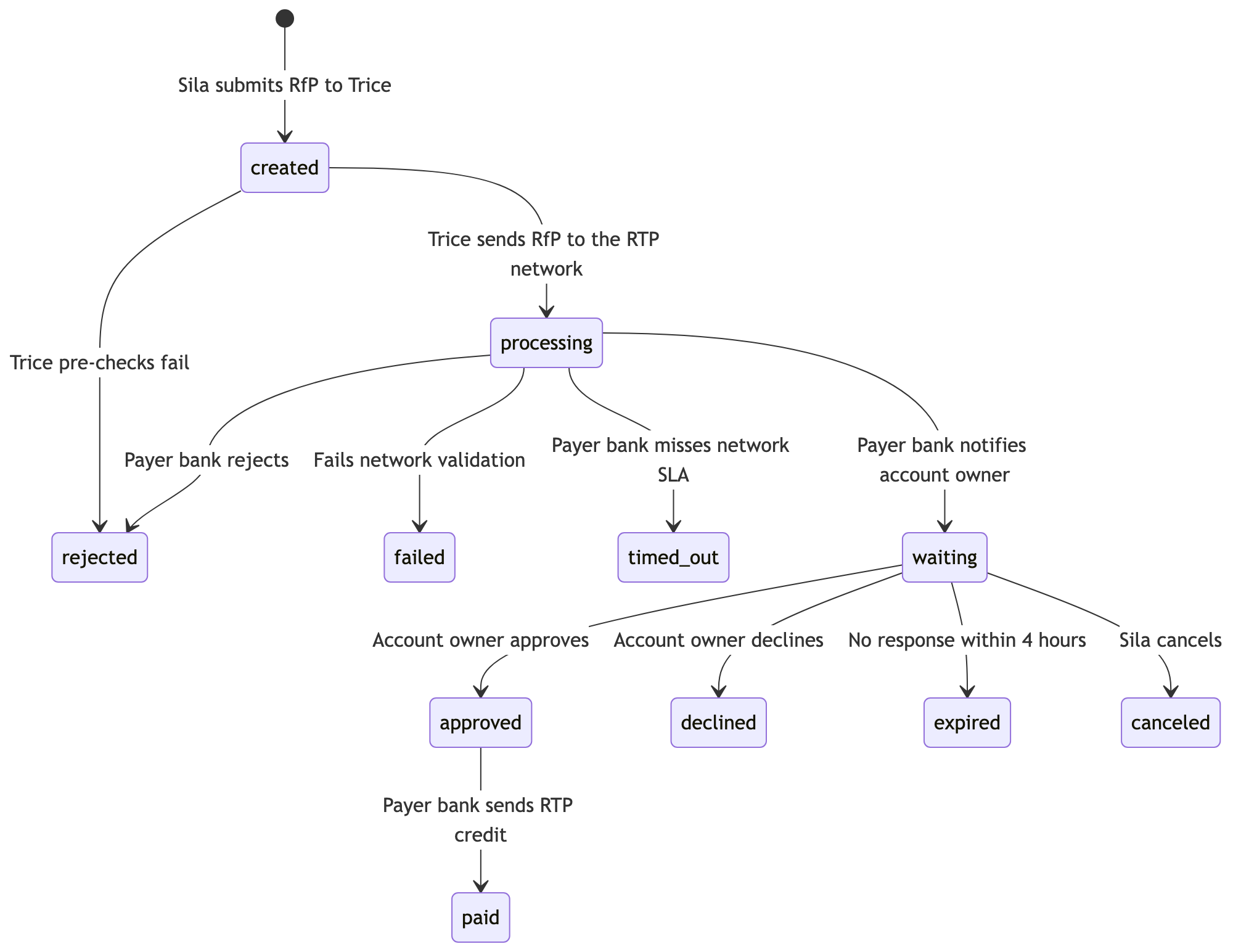
created: Sila submits the RfP to Trice. If Trice's pre-checks fail, the RfP goes torejected.processing: Trice sends the RfP to the RTP network and waits for an acknowledgement. If none arrives within 30 seconds, Trice asks the network for the status. The RfP ends here if:- it fails the network's validation (
failed, with a reason code), - the payer's bank rejects it (
rejected, with a reason code), or - the payer's bank doesn't answer within the network's time limit (
timed_out).
- it fails the network's validation (
waiting: the payer's bank accepted the RfP and notified the account owner. How the bank notifies them (mobile app, online banking, or something else) is up to the bank.- The account owner responds, or doesn't:
approved: the owner approved the request. No money has moved yet.declined: the owner declined to pay.expired: the owner didn't respond within 4 hours.canceled: Sila canceled the RfP.
paid: after approval, the payer's bank sends an RTP credit transfer for the RfP. Once it arrives, the RfP ispaid. This is the only successful outcome.
rejectedis the bank's answer, not the account owner'sA
rejectedRfP never reached the account owner: Trice's pre-checks or the payer's bank stopped it first. Once an RfP iswaiting, the bank has already accepted it, and the owner can only approve or decline.
Status reference
The Sila transaction stays pending until the RfP reaches a final status.
| Trice status | Meaning | Final | Sila transaction |
|---|---|---|---|
created | Trice received the RfP. | No | Pending |
processing | Sent to the RTP network; awaiting acknowledgement. | No | Pending |
waiting | The payer's bank notified the account owner. | No | Pending |
approved | The account owner approved; payment not yet received. | No | Pending |
paid | The payer's bank sent the funds. | Yes | Success |
declined | The account owner declined. | Yes | Failed |
expired | No response within the 4-hour window. | Yes | Failed |
canceled | Sila canceled the RfP. | Yes | Failed |
rejected | Trice's pre-checks or the payer's bank rejected it. | Yes | Failed |
failed | Failed RTP network validation. | Yes | Failed |
timed_out | The payer's bank didn't answer within the network SLA. | Yes | Failed |
Expiration
Every RfP Sila sends expires after 4 hours. Sila sets this window; it isn't an RTP network rule.
If the account owner doesn't approve or decline within that window, the RfP goes to expired and the Sila transaction fails.
How the account owner is notified
The payer's bank decides how to notify the account owner and how the owner responds. Neither Trice nor The Clearing House specifies the channel, and Sila has no control over it.
This step is one of the most common points of failure for an RfP. If the account owner doesn't see the bank's notification, or doesn't act on it within the 4-hour window, the RfP goes to expired and the Sila transaction fails.
The owner sees the presentment's sender name, memo, and billing phone number, along with the requested amount.
References
Updated about 23 hours ago